A3Guide
Food-safe storage containers: how to tell which bins can hold food
The short answer
A container is food safe when its maker says it is made for food storage or food contact, on the label, pack or product page. The recycling-style number on the base only identifies the plastic. For loose staples, use containers sold for food, ideally with an airtight gasket lid.
How can you tell if a storage container is food safe?
Look for the maker's own statement: words such as food safe, food storage or suitable for food contact on the label, packaging or product page. If there is no such statement, treat the container as storage for objects and packaged food only. Shape, clarity and the resin number tell you nothing about food use.
In the U.S., the FDA regulates the substances used in materials that touch food, and companies need those uses authorized before they market them. That is why the maker’s food-contact statement matters: it tells you the product was made for that use. Some storage ranges say the opposite plainly. IKEA’s listing for its SAMLA clear boxes, for example, says they are not approved for food contact.
- Pack or label says food safe, food storage or food contact.
- Product page lists it under food storage, not general storage.
- Care notes mention dishwasher, freezer or microwave use (a sign it was designed around food).
- No statement? Use it for packaged food or objects only.
What does the number in the triangle on plastic mean?
It is the resin identification code, a number from 1 to 7 that identifies the type of plastic: 2 is high-density polyethylene, 5 is polypropylene, and so on. It is set out in ASTM standard D7611. It is not a food-safety mark, and ASTM says it doesn't mean the item is recycled or recyclable.
| Code | Plastic | Typical in storage |
|---|---|---|
| 2 | High-density polyethylene (HDPE) | Tough totes, crates |
| 4 | Low-density polyethylene (LDPE) | Flexible lids, bags |
| 5 | Polypropylene (PP) | Clear and frosted boxes, food containers |
| 6 | Polystyrene (PS) | Rigid small organizers |
| 7 | Other | Mixed or other resins, including some clear plastics |
Should you decant pantry food into containers?
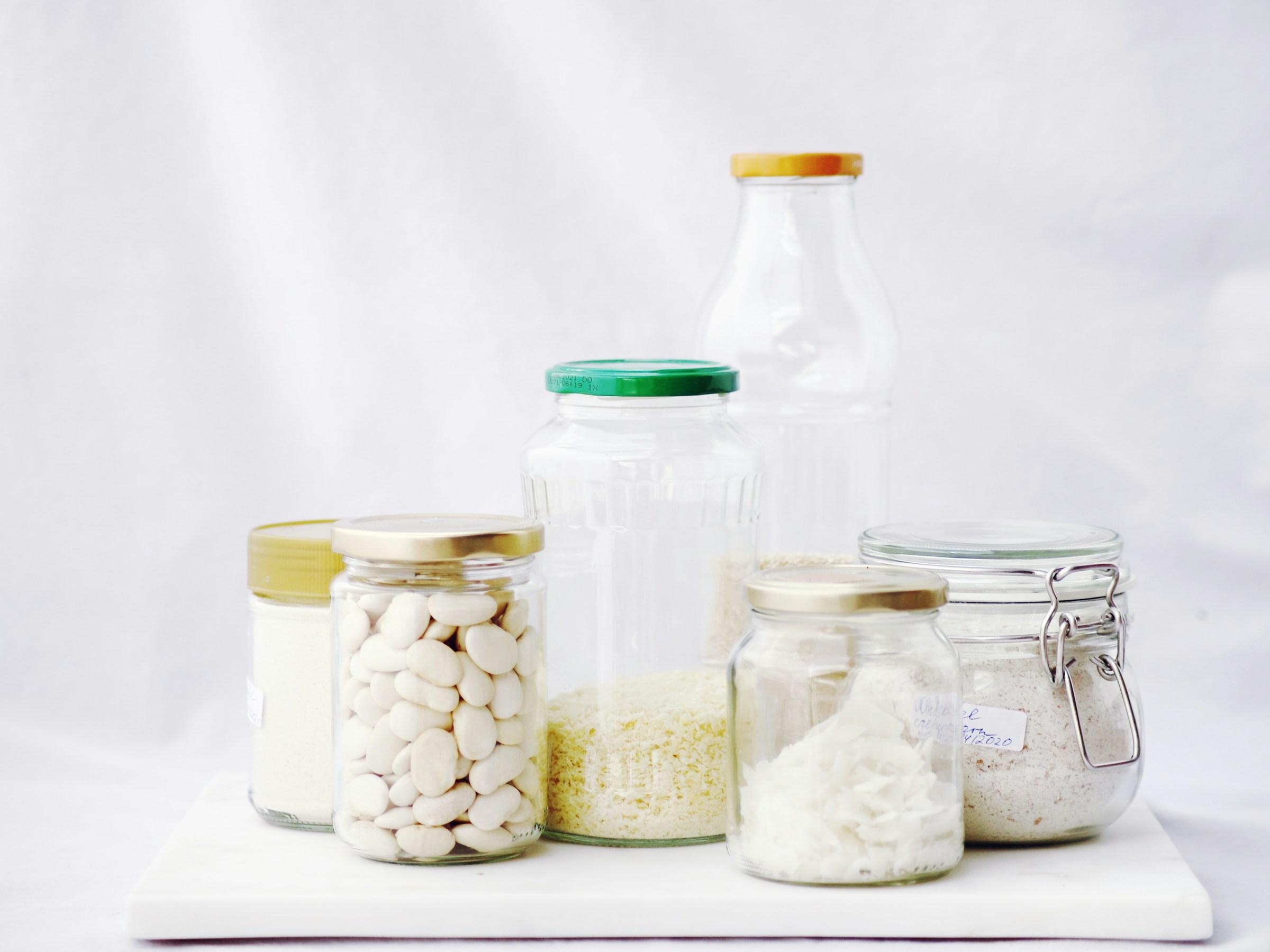
Decant the staples you use often and buy in bulk, such as rice, oats, pasta, flour and cereal, into airtight food containers: they stay fresher, stack neatly and show what's running low. Keep packets, cans and things with cooking instructions in their own packaging, grouped inside clear open-front bins.
Why do airtight containers matter in a pantry?
An airtight lid keeps air and humidity away from dry goods, so crackers stay crisp and flour stays dry, and it shuts out pantry pests that get into open bags. Look for a gasket in the lid and a positive close: a clamp, a latch, a screw top or a push button.
Push-button canisters such as OXO’s POP range seal with a silicone gasket and are sold for pantry staples. Clamp-top glass jars do the same job with a rubber ring. Whatever you choose, check that the gasket comes out for washing.
How do you clean and care for food storage containers?
Follow the maker's care notes. Wash containers and lids before first use and between refills, take gaskets out and dry everything fully before refilling, and never top up old food with new. Replace containers whose seals have cracked or warped, because a lid that no longer seals isn't doing its job.
Next: set up the shelves in pantry storage bins, and label them with a labeling system that lasts.
What does the glass and fork symbol mean on containers?
The glass and fork symbol marks a material as intended for contact with food. It is used in the European Union, where food contact materials must comply with Regulation (EC) No 1935/2004. In the U.S. there is no single required symbol, so look for the maker's food-safe or food storage statement on the pack or product page instead.
Can you reuse other containers for food storage?
Only containers made for food. Penn State Extension warns against storing food in containers that held cleaning chemicals or other non-food products, and in ordinary trash bags, because they are not made with food in mind. Reusing a clean food jar for dry goods is a different matter: it was made for food to begin with.
When should you replace a food storage container?
Replace it when the lid no longer seals, the plastic is cracked, warped or deeply scratched, or it keeps a stain or smell after washing. A container that can't seal can't keep air, moisture or pests out, which is its whole job. Glass jars last longer, but their rubber gaskets wear out and need replacing.
Frequently asked questions
No. The number inside the triangle is a resin identification code: it tells you what kind of plastic the item is made of, such as 5 for polypropylene. It is not a food-safety mark, and ASTM, which publishes the code standard, says it does not mean the item is recycled or recyclable either.
Not loose, unless the maker says the bin is suitable for food. General storage boxes are often made for objects, and some are labeled as not approved for food contact. Keep food in its own packaging inside a general bin, or decant it into containers sold for food storage, ideally airtight.
A seal in the lid, usually a silicone or rubber gasket, pressed down by a clamp, latch or push button. OXO's POP containers, for example, use a push-button lid with a silicone gasket. Airtight lids keep dry goods fresher and help keep pantry pests out of what's inside.
Glass doesn't stain or hold smells and lets you see the level, but it is heavy and breaks. Plastic made for food is light and safer on high shelves and around children. Many pantries use both: glass at eye level, food-grade plastic up high, and both with good seals.
Sources
- 1.Food Packaging & Other Substances that Come in Contact with Food: Information for ConsumersU.S. Food and Drug Administration
- 2.ASTM D7611/D7611M: Standard Practice for Coding Plastic Manufactured Articles for Resin IdentificationASTM International
- 3.SAMLA box, clear (product page)IKEA
- 4.POP Container 3-Piece Set (product page)OXO
- 5.Food contact materialsEuropean Commission, Food Safety
- 6.Unacceptable Food Storage ContainersPenn State Extension, updated Aug 25, 2025
Sources checked . Product ranges change, so confirm sizes and specs with the maker before you buy. We are independent and no company named pays us. Read the disclaimer or how we check facts.